While parking lots are on the wane in some parts of town, that's not the case everywhere. Houses in Truxton Circle have been torn down at a notable rate recently, and some of those have simply been turned into expanses of asphalt to house cars instead of people.
Parking lots draw the ire of many who live in DC. They're not the best use for limited city land and they're often ugly in appearance. Close to downtown in recent years, though, they have been replaced by buildings that increase the city's tax base by providing more space for residents and businesses. Often, these new buildings increase the amount of parking in the city, as there are more spaces in two or three levels of underground parking than there are at one level on the surface.
A couple weeks ago, at the Other 35 Percent, Cary Silverman mentioned a proposed change in Baltimore's zoning code that would require that vacant lots be used for parkland or green space instead of parking lots after buildings are torn down.
This isn't the rule in DC. Temporary parking lots proliferate in places where buildings have been recently torn down. All over Near Southeast and Southwest near the Nationals ballpark, parking lots were built on land that is intended to be developed, once the economy turns a corner and demand for new construction increases. Another recent example of a new parking lot can be found just east of North Capitol Street on the unit block of P Street.
(This isn't the beautiful Hawaiian landscape that inspired the line from Joni Mitchell's "Big Yellow Taxi" in the title, but please indulge me.)
At my old blog, bloomingdale (for now), I noted a garish pop-up that was being constructed on the unit block of P Street NE. Next door to that abomination were the burned-out shells of rowhouses that had existed on the site for a century. Those shells used to house people, but they had become vacant and neglected. There are and have been many more houses similar to those that have been successfully been turned back into nice houses lived in by people who pay taxes and contribute to city life.
Eventually, the news came that these houses were to be torn down instead of being renovated for some contributing use. I documented the demolition of those houses, asking the construction crew what use was intended for the property. At the time, I was told it would become an apartment building.
In the meantime, the local real estate market tanked, especially in sub-markets that would be considered "marginal." Truxton Circle, (especially along North Capitol Street) could certainly be considered one of those marginal markets. Whether an apartment building was ever really intended for those lots we'll likely never know. (I checked DCRA's PIVS website for construction permits at these properties, and found nothing.)
So, what became of that empty land? A parking lot:
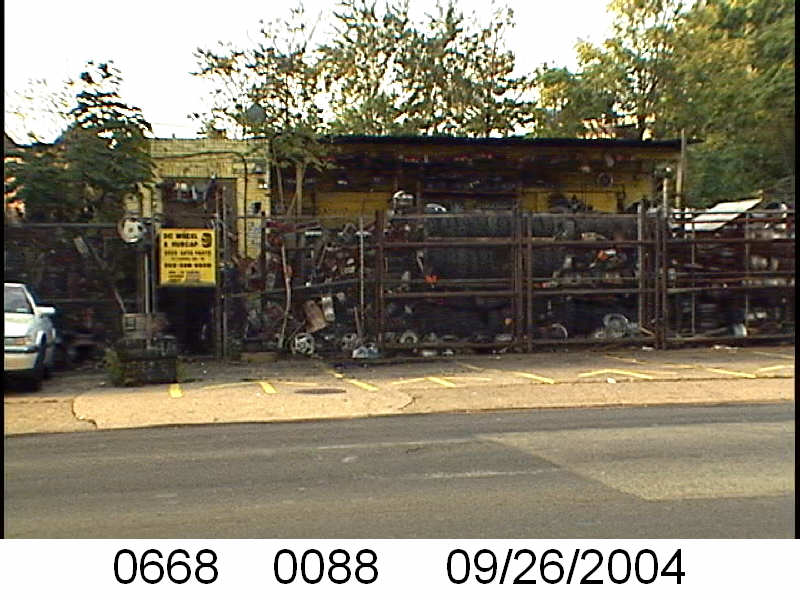
Granted, it wasn't all buildings beforehand. There was a used tire store there as well (see what it looked like in 2004 here), so one could argue an empty lot isn't the ugliest thing possible on this space. Today, though, what good is a parking lot on that land? There is plenty of parking nearby for those who might be driving to the their jobs across the street at DDOT's offices:
Other new office space built nearby has plenty of underground parking, and is within a very short walk of the New York Avenue Metro station.
Would a nice temporary green space have worked here? It's hard to say, but that part of the city and Ward 5 certainly has very little green space, and could use every little bit it can get. Look at this map (it's a PDF) from the Capital Space plan, and note that there is a area devoid of large parks centered on the Eckington and Truxton Circle neighborhoods.
I don't see how an empty parking lot (since it doesn't appear to be attracting a lot of business) could possibly pay the bills.
Cross-posted at Greater Greater Washington.
Showing posts with label historic preservation. Show all posts
09 July 2010
05 May 2010
Chip, chip, chipping away at DC's historic housing stock
The 700 block of 2nd Street NE is home to rowhouses and an enormous rear alley structure that are doomed to be destroyed. According to DCmud, these properties are owned by the Louis Dreyfus Property Group, who intends to tear the buildings down and construct a Planned Unit Development (PUD) which would consist of a large apartment building, among other uses, adding density to the neighborhood but sacrificing some of its character.
Where these buildings two blocks south, they would have been protected by the Capitol Hill Historic District:
Ironically, DCmud states that part of the trade-off for these buildings' destruction would be that Dreyfus would pay for a study that could potentially lead to an expansion of the historic district (too late for these buildings, though). I stressed the potential aspect of this, because in recent years, we've seen attempts to establish historic districts fail as often as they have succeeded.
In the last week, fencing has gone up around the buildings (see pictures below). Take special note of the last photograph, which shows a large building in the alley, too large to call a carriage house. It appears to have been a light-industrial building of some sort (perhaps Richard Layman can chime in and give some more background about this building). Regardless, there are some solid structures that will be lost when they are finally torn down, to be replaced by something that I don't hesitate to say will likely not have any kind of the permanence many of these buildings have exhibited.
I've heard people argue that it's alright if we lose a historic building or two here and there. What's the big deal? DC has thousands of them! The benefits of increased density far outweigh the loss of historic residential stock.
But I have pointed out before on my old blog that we are constantly losing these old houses to neglect or, as Layman astutely points out, a malady he calls "blaming the building" (mentioned here as well). The chipping away of our historical housing stock is especially disturbing to me in neighborhoods where most of this housing still exists in contiguous blocks. Part of what makes Bloomingdale such a nice neighborhood architecturally is the fact that, block-by-block, the original houses are all still standing. Shaw, on the other hand, has many places (particularly along the streets that were decimated in the 1968 riots) where that continuity is interrupted by 'modern' public housing projects or commercial structures that stand out like sore thumbs in the streetscape.
Perhaps witnessing the loss of more old structures convinces people in neighborhoods to rally for historic district status. The residents of Barney Circle are leading the way. Hopefully more neighborhoods (like Eckington and Bloomingdale, Brookland and Chevy Chase) will take note of the potential losses and do what's necessary to keep their neighborhoods from being destroyed one house at a time.
Where these buildings two blocks south, they would have been protected by the Capitol Hill Historic District:
Map from the Capitol Hill Restoration Society website (PDF).
Ironically, DCmud states that part of the trade-off for these buildings' destruction would be that Dreyfus would pay for a study that could potentially lead to an expansion of the historic district (too late for these buildings, though). I stressed the potential aspect of this, because in recent years, we've seen attempts to establish historic districts fail as often as they have succeeded.
In the last week, fencing has gone up around the buildings (see pictures below). Take special note of the last photograph, which shows a large building in the alley, too large to call a carriage house. It appears to have been a light-industrial building of some sort (perhaps Richard Layman can chime in and give some more background about this building). Regardless, there are some solid structures that will be lost when they are finally torn down, to be replaced by something that I don't hesitate to say will likely not have any kind of the permanence many of these buildings have exhibited.
I've heard people argue that it's alright if we lose a historic building or two here and there. What's the big deal? DC has thousands of them! The benefits of increased density far outweigh the loss of historic residential stock.
But I have pointed out before on my old blog that we are constantly losing these old houses to neglect or, as Layman astutely points out, a malady he calls "blaming the building" (mentioned here as well). The chipping away of our historical housing stock is especially disturbing to me in neighborhoods where most of this housing still exists in contiguous blocks. Part of what makes Bloomingdale such a nice neighborhood architecturally is the fact that, block-by-block, the original houses are all still standing. Shaw, on the other hand, has many places (particularly along the streets that were decimated in the 1968 riots) where that continuity is interrupted by 'modern' public housing projects or commercial structures that stand out like sore thumbs in the streetscape.
Perhaps witnessing the loss of more old structures convinces people in neighborhoods to rally for historic district status. The residents of Barney Circle are leading the way. Hopefully more neighborhoods (like Eckington and Bloomingdale, Brookland and Chevy Chase) will take note of the potential losses and do what's necessary to keep their neighborhoods from being destroyed one house at a time.
Tags:
Dreyfus,
H Street NE,
historic preservation
Subscribe to:
Posts (Atom)