Showing posts with label DDOT. Show all posts

22 February 2013

DDOT photo of the old Sears building on Bladensburg Road

I was poking around in DDOT's photo archive on Flickr last night, and I came across the following photo:

Southeast/Southwest Freeway 1968 (DDOT on Flickr)

It's a picture of the construction of the Southeast/Southwest freeway through Capitol Hill in the late 1960s. It's a stark reminder that the freeway cut a neighborhood in two, and it's a scar that we'll likely continue to have for decades to come.

What caught my eye, though, was the bright patch at the top of the photograph. I've cropped that section out, enlarged it, and circled the interesting spot below:


You can click above to enlarge it even more. I'm pretty sure this is the old Sears, Roebuck & Co. building. (At that link, you can see a photograph of this amazing Art Deco building, which was still standing until the late 80s/early 90s). It was located on Bladensburg Road, just north of the Starburst intersection, across the street from Trinidad. It's now the location of the Flats at Atlas apartment building, which is better than a vacant lot, but certainly not as cool as a repurposed Art Deco beauty would have been.

07 March 2012

Traffic bollards at 2nd Street and Florida Avenue NE need help

When DDOT completed the reconstruction of the intersection of New York Avenue, Florida Avenue, 1st Street, O Street, and Eckington Place NE (known by some as "Dave Thomas Circle"), they included plastic bollards in the part of the Florida Avenue roadway immediately east of the intersection to control traffic coming out of the somewhat blind corner with 2nd Street NE. Unfortunately, those bollards need maintenance and replacement, and DDOT needs to step up to keep this intersection safe.

On August 22, 2011, I sent a 311 request (number 11-00259888) for bollard replacement. Many had been run over or were missing, and I frequently observed dangerous and illegal turns. The request wasn't resolved for over 3 months. On December 2, 2011, I received the short reply "NO WORK NEEDS TO BE PERFORMED. PER VICTOR N."


As of this morning, it appears that a vehicle ran over many of the remaining bollards. Debris is scattered all over the roadway and adjoining sidewalk. Bollards are either missing, snapped in half, or have been pushed off their moorings and are certain to fall under the wheels of passing vehicles sooner or later. Someone has taken the time to collect a few bollards and place them behind the guardrail that keep traffic away from the nearby rail overpass.


This intersection will likely be reconfigured when the Washington Gateway development on the north side of the block is completed, but it's doubtful that will happen in this calendar year. In the meantime, I hope DDOT will go out and make the simple repairs necessary to keep this intersection safe for those driving, cycling, and walking through it. They've certainly shown to be responsive about simple things, like updating road paint, that make a big difference, before.

19 January 2012

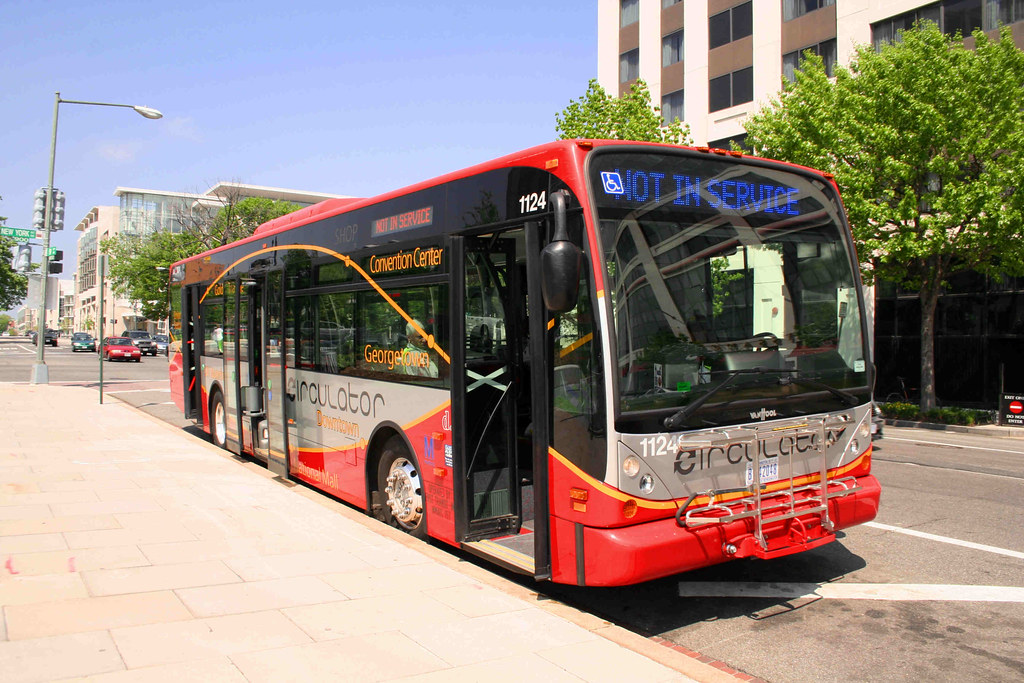
UPDATED: Attempted assault with a Circulator bus

UPDATE: A representative from WMATA called back to let me know that the driver had been identified and served with a two-day suspension (without pay). He will also have to undergo remedial training when he returns to active duty.

(The original post continues below.)

Photo by Elvert Barnes on Flickr.
The "Assault of Bicyclist Prevention Act of 2011" is still bottled up in the D.C. Council's Committee on Public Safety and the Judiciary, which is chaired by Councilmember Phil Mendelson. Though the bill was introduced last September by nine sponsors (a supermajority of the council), it hasn't been moved to the committee of the whole in any form. Here's one example of the assaults that happen every day on our city's streets, necessitating action on the part of the D.C. Council to protect cyclists from harm.

------

Wednesday night, I was biking home from the New York Avenue station, heading eastbound on Florida Avenue NE. When I got to West Virginia Avenue, I turned left (north) and headed into Trinidad. I took note of the fact that there were a couple cars and a Circulator bus heading north on West Virginia Avenue, waiting at the light. I always check traffic there, because I know that any vehicles will catch up to me on West Virginia Avenue within a few seconds after I make my turn.

I took the lane on West Virginia, as I always do, to avoid being doored by parked cars, and to avoid being squeezed into those cars by traffic overtaking me. By the time we reached Morse Street NE, one block up the road, both of the cars had been able to pass me, but oncoming (southbound) traffic kept the bus from being able to do the same. I knew he was still behind me, but wasn't sure quite how far back. Suddenly, the driver accelerated so that the bus was just a couple feet behind my rear wheel. He began honking. I turned back to look, and he was waving his arms and shouting. The driver was not in total control of the bus, or his emotions for that matter.

I realize I am outspoken about the right of cyclists to use the road just like anyone else, and I realize that there are a lot of cyclists in the city that break the law. Drivers of all stripes complain about this and say that they'll respect cyclists as soon as cyclists start following the rules.

Last night's incident was a perfect example of a cyclist following the law (taking the lane was my right—it's even a signed bicycle route—I had front and rear lights on the bike, and I was wearing a helmet and a reflective strip on my pants). This bus driver decided he would use his multi-ton vehicle to intimidate and harass me. No physical harm occurred, ultimately, but his reckless actions could have led to my death had he accidentally accelerated a little more. Putting the two of us in that position is nothing but negligent. I don't know what kind of reprimand can be given to the driver, but it should be easy to identify him.

Actions such as this are absolutely intolerable, and until people start realizing that there are consequences to childish behavior like that, I fear that this kind of thing will continue to happen until - oops - someone is maimed or killed.

Patience and respect are a two-way street. I gave, but did not receive it last night. That bus driver needs to be retrained on how to operate on DC's streets, or he should be removed from them permanently.

------

I sent a version of the above in a letter to DDOT, and ultimately received a phone call from WMATA, as they manage the Circulator program. The WMATA representative was professional, kind, and understanding, and she promised me the bus driver would be identified and spoken with. She acknowledged that his actions not only could have hurt me, but any injury to a cyclist could have caused him to lose his job. I'm very grateful for the professional follow-up from DDOT and WMATA.

West Virginia Avenue NE is slated to get dedicated bicycle lanes this year on the entire stretch from Florida Avenue NE to Mount Olivet Road NE. Hopefully the additional markings will make it even more clear that bicyclists have just as much right to use the road as motorized traffic.

22 August 2010

Update about street trees

Back on August 10th, we posted an article about street trees, which included opinions about what we feel needs to be done to ensure that taxpayer money is being spent effectively when planting and maintaining these trees. The article was cross-posted on Greater Greater Washington as well.

On Thursday, DDOT replied. Karyn LeBlanc wrote that the "US Environmental Protection Agency’s MS4 Permit requires the District government to plant at least 4,150 trees every year." (MS4 stands for "Municipal Separate Storm Sewer Systems.")

The big news was that the Urban Forestry Administration will be rebranded "d.Trees" in the near future.

It's always reassuring to see a government agency paying attention to the concerns of the taxpayers. Hopefully this rebranding will lead to even more focus on outreach with the residents of the city.

10 August 2010

Street tree care—How can it improve?

The appropriateness of the nickname "City of Trees" is at risk here in Washington, DC, but there is hope that change to the way our city's trees are cared for will make this nickname relevant again, and soon.

In the August 4th edition of the Dupont Current (I wish I could link directly to the story, but the Current has a strong dislike of Internet publishing), there is a story about the DC "Tree Fund." The fund is partially filled by fees levied as part of the Urban Forest Preservation Act of 2002, and is legally required to be kept separate from the city's general fund. The Current says that the 2011 budget, proposed by the mayor and approved by the council, removes money from the fund and places it in the city's general fund. I'm no expert regarding the execution of DC law, but this appears to be in direct opposition to the spirit, if not the letter, of the Urban Forest Preservation Act.

In the article, Councilmember Mary Cheh (D-Ward 3) states she wasn't aware that the money was being diverted from the Tree Fund into the general fund when she voted for the budget. [Personal aside: I think this is a dereliction of duty—if your job is to legislate, and if you're voting in favor of legislation that you're not familiar with, you have no right to complain about what was in it later. If there isn't enough time to read and understand everything in the legislation, don't cast a vote.]

The government agency tasked with planting and maintaining street trees in DC is the Urban Forestry Administration (UFA), which is part of the District Department of Transportation (DDOT). I recently had the opportunity to speak with John P. Thomas, the Urban Forestry Administration's Chief Forester, about some details of the city's street tree planting and maintenance program.

DDOT's yearly street tree budget is $7.5 million. As John Kelly noted on Sunday, the city is not responsible for watering trees once they are planted (contractors plant most of the street trees in the city). Mr. Thomas told me that watering will be a line item in the planting contract this coming year. It will most likely mean that the city will not be able to plant as many trees as they have in years past, but I see that as a net-positive for the DC.

A few years ago, the city planted trees in the median of North Capitol Street, from Michigan Avenue to Hawaii Avenue, while the street was undergoing a complete reconstruction. The trees all died within the year, due to a lack of water. Casey Trees recommends that a newly-planted street tree receive twenty-five gallons of water per week for the first three years while establishing a healthy root system. [In the interest of full disclosure, I am a Casey Trees Citizen Forester.]

Over the last year, the city reconstructed Brentwood Road NE from Rhode Island Avenue south to T Street. That reconstruction included the planting of approximately 64 new trees in the treeboxes lining the street. The photographs at the top of this article and to the right show the condition of the trees on this stretch of road now—namely, they've nearly all died. On a recent weekend, I counted only four trees, or 6% of the total from this project, that remain alive. Weeds choke the treeboxes that line the street (save two in front of the Lowest Price Gas Station, where the trees are still dead), all of them neglected. That's unacceptable.

A new section of the Metropolitan Branch Trail recently opened between the New York Avenue Metro Station and Franklin Street NE. Trees were planted along the trail at many points, including the pocket park pictured at 4th and S Streets NE. Many of the trees are already dead due to the extremely dry spell we had in June and early July.

All of that is unfortunate, and easily could have been prevented, had the property owners and neighbors along the Met Branch Trail and Brentwood Road taken the time to water the nearby trees, or if the city had planned to water the trees in the North Capitol Street median, as the road there is practically a freeway where watering would be difficult. But there is hope ahead!

The city is actively working on a streetscape plan for the entire length of Sherman Avenue NW, between New Hampshire and Florida Avenues. One of the elements of this reconstruction will be a planted median. After seeing what happened on roads like North Capitol Street, it's reasonable to see why residents might be skeptical that trees could survive without a dedicated source of water to keep them alive. Thankfully, Sherman Avenue resident Craig Sallinger was able to get a guarantee from a DDOT employee that an irrigation system will be included in the construction of the road, so it will be easy to get water to those trees while they're trying to establish roots. Hopefully this will be a consideration DDOT makes in all of their future streetscape programs.

Spending money on in-ground watering systems and paying more individuals (be they UFA contractors or students employed during the summer) will inevitably take money away from actual tree planting. I think that's a good thing.

I'm not saying I want less trees—I want more! But I want them to be mature and healthy, not first-year seedlings, struggling to stay alive.

DDOT's current planting process doesn't work, through no fault of their own. Mr. Thomas noted that 95% of what they plant comes from citizen requests for trees in front of their house. A program called "Canopy Keepers" exists to encourage citizens to water the young trees on their street. Some of my friends here in Trinidad are participating in this program. Walking around the city, though, you can easily see that many citizens are not holding up their end of the bargain. The UFA staff does an admirable job with limited resources, but I believe it would be better to help young trees mature instead of wasting those resources replacing trees year after year.

You can only count on the kindness of strangers to a certain point. Eventually, money talks, and it can also water trees.

Cross-posted at Greater Greater Washington.

21 April 2010

Streetcar details revealed at open house in Trinidad

Residents heard about the maintenance yard for the H Street NE streetcar line, how the system will tie in to Union Station, and how the streetcars will be powered at Tuesday's meeting hosted by the District Department of Transportation (DDOT) at Trinidad's Wheatley Education Campus on the 1200 block of Neal Street NE.

Photo by erin_m.

DDOT's Scott Kubly, head of the Progressive Transportation Services Administration (PTSA) presented illustrations to the packed gymnasium at Wheatley Education Campus showing how the western end of the H Street line will continue below the railroad tracks, ending at a maintenance yard under the Hopscotch Bridge. Streetcars could be running in service by the spring of 2012.

William Shelton, chairman of ANC 5B, introduced the meeting, and Councilmember Tommy Wells spoke of the importance of linking Wards 5 and 7 to Union Station ("from which you can travel to anywhere in the world").

DDOT Director Gabe Klein stressed that the city is working on the "three P's: public safety, public schools, and public spaces," and said improving these will bring business, development, and families back to the city. He mentioned the fact that the city had over 800,000 residents at its peak in the 1950s and that the population is now increasing.

Rendering of streetcar stop along Benning Road. Image from DDOT.

Mr. Klein also made news by stating that DDOT is working with the National Capital Planning Commission (NCPC) on a compromise regarding overhead wires as a power source for the streetcars, stating NCPC is "very open to compromise."

Finally, Scott Kubly took the stage to discuss some of the details of the H Street/Benning Road streetcar line. DDOT has submitted a $25 million grant application to the Federal Transit Administration (FTA) to help fund the $75 million necessary to extend it across the Anacostia River to the Benning Road Metro station. The FY2011 budget includes an additional $63 million needed to complete construction and make the H Street line fully functional.

Mr. Kubly also mentioned his hopes for an overhead wire compromise with NCPC. An interesting fact he brought up (which was difficult to hear due to the fact that he was battling serious laryngitis) was that a wider pantograph on the streetcars would mean even less obtrusive wires are required to produce the necessary power for the cars.

The three streetcars that are currently being stored in Greenbelt will soon be brought to the District for citizens to have an opportunity to walk through the cars and see them firsthand.

The western end of the H Street line, which currently ends at 3rd Street NE, will continue two blocks west via a hole punched through the Hopscotch Bridge, crossing 2nd street at grade, and by entering the old H Street tunnel under the railroad tracks, similar to the tunnels at K, L, and M Streets. The entrance to the H Street tunnel is visible at the right hand side of this historical photograph taken in 1969.

Renderings of streetcars descending through the Hopscotch Bridge (left) and in the tunnel under the railroad tracks (right). Images from DDOT. Click to enlarge.

After crossing under the tracks, the streetcars will emerge at 1st Street NE, cross the street at grade, and enter a maintenance yard under the Hopscotch Bridge between 1st Street and North Capitol, concealed from public view.

Schematic of the maintenance yard (left), 1st Street NE (center), the Union Station stop, and tracks toward H Street (right). Image from DDOT. Click to enlarge.

Three new power substations will provide power for this line, located at 26th Street and Benning Road NE (just north of the kiosk library), a vacant lot at 1215 Wylie Street NE, and under the Hopscotch Bridge in the 200 block of H Street NE. Each will measure approximately 15 by 40 feet, and will be constructed to blend in with the surrounding area.

The platform at 1st Street NE will connect directly to the north mezzanine of the Union Station Metro station via a tunnel that was started but never completed in 1975 when the Metro was built. 510 of the tunnel's 600 feet is complete; the remaining 90 feet will have to be dug as part of the current construction. DDOT plans a single platform and track here, as there is currently not enough room for a parallel track and platform due to limited space and ADA requirements for space to enter and exit the streetcars.

The temporary eastern end of the line (at Benning Road and Oklahoma Avenue) will consist of a short stub track that allows for eastbound streetcars to turn back towards Union Station. That stub will be integrated into the route towards the Benning Road station when that part of the line is completed.

Construction at the ends of the line should commence in Fall 2010, and be complete by Winter 2012, allowing the streetcars to begin running in Spring 2012.

The question and answer session was very cordial, with most people asking short questions about operational issues including how traffic would be affected, automobile parking, signage for the deaf community, and safety concerns for the elderly. A couple queries about the status of streetcar propulsion (the overhead wire question) were raised, but there was none of the contentious back-and-forth that might have been expected.

At the end of the evening, Wheatley's principal Scott Cartland asked those of us in the audience to help stack the chairs and clean up the gym since the staff had gone home for the evening and there was only one janitor to handle everything overnight. We gladly lent a helping hand, thanked the presenters, and stepped back out into the comfortable night air.

Cross-posted at Greater Greater Washington.

08 April 2010

Update from WASA—and more water springs forth from the Earth

Over the last month, I've learned quite a bit about the terminology involved in the repair and upkeep of our city's water delivery system. The back-and-forth that I've had over email with WASA has been enlightening.

It all started with an angry Tweet from me on March 9. WASA's Twitter feed, to that point, was simply a way of forwarding occasional notices for city blocks that would be subjected to a "work zone" that day. After witnessing how well DCRA interacts with the public on Twitter, I was spoiled and believed that every city agency should communicate in the same way (I still DO feel that way).

Shortly after that angry Tweet, WASA announced that it was going to start two-way communication using its Twitter account. Can I claim that I was responsible for this flowering of openness? Probably not, but I like to think the attention helped get them moving forward.

Anyway, after yesterday's post regarding the mysterious leak on Montello Avenue NE in Trinidad, I received another follow-up from Alan Heymann, WASA's Public Affairs Director:
Our Director of Water Services spoke with the various foremen who have been involved with work in the 1600 block of Montello Ave. Here is what he heard, and what we plan to do next.

DC WASA repaired a leak further north toward Raum Street. When shutting off the main to do the repair, the crew found the valve at Montello and Raum to be defective. Water Services then scheduled a shutdown to replace the valve. When water on the 1600 block of Montello was shut down for the valve replacement, the water surfacing in the middle of the block did not stop. We tested the water from the street for fluoride, because groundwater, treated drinking water and wastewater typically have different levels. This often helps us determine what kind of water is surfacing. Because the sample revealed little fluoride, and because the water didn’t stop when we shut down the main, we determined that the source was not a WASA pipe, but groundwater. When we encounter groundwater coming to the surface, we work with DDOT to reroute it into a drain.

As a result of your post, we are expanding the investigation. An investigation crew will listen for a leak along Holbrook Terrace and Meigs Place today. If any sounds are detected, a crew is scheduled to return tomorrow to drill test holes over the main to try to pinpoint the source of the sound and determine if there is a leak. If no sound, the crew will excavate south of the existing pothole and observe how the water is entering the excavation. While the hole is exposed, we will shut down the mains in Holbrook Terrace and Meigs Place for a short duration to see if the water stops or slows down. We will also take another sample.

Therefore, we will not do any excavating until Thursday.
This is exciting, and it'll be interesting to see what WASA and DDOT end up having to do to get this fixed.

Not wanting to pile on the requests regarding water coming out of the woodwork in our neck of the woods, but when they've figured out what the deal is on Montello Avenue NE, there is this little situation on Mount Olivet Road NE between Gallaudet University's campus and Ivy City since at least last September...