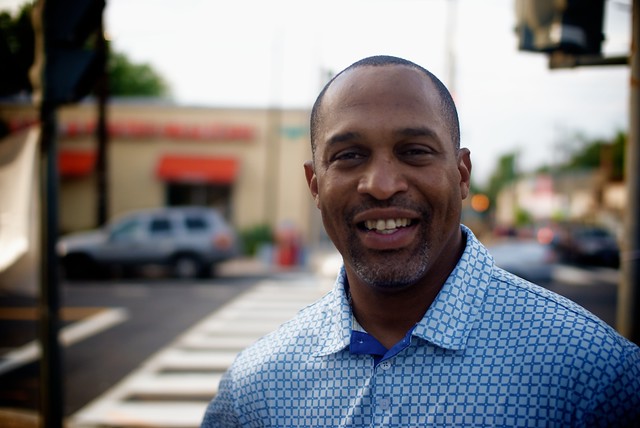
I'm often the first person to complain about what I perceive (and others agree) to be a lack of good customer service here in DC. When I see good service, though, I think it's worth shouting to the heavens so everyone knows about it. Tonight, that great service came from Jim at the CVS on Bladensburg Road next to the Hechinger Mall.
Jim was the security guard working the area near the front door. He was doing the work of a guard, as well as a greeter and a customer service representative. I had stopped in to purchase some salt in anticipation of the forecasted nasty weather, and saw a stack of salt bags near the front door. Not clear if these were for store employees to spread outside on the sidewalk, I asked Jim if I could purchase a bag.
"Absolutely," he replied. He reached down, lifted a bag, and walked it over to the scanner next to the aisle end-cap to let me know how much one cost. There were two women standing in front of the scanner, and Jim politely asked them to move so he could scan the bag. He was greeted with anything but politeness.
One of the women proceeded to berate Jim for a good 30 seconds, telling him with no uncertainty that she could do whatever she damn well pleased. Jim stood there and took it. When the rude misanthrope and her henchwoman finally decided to shuffle along, she made sure to loudly shout slurs and insults about Jim and his profession so everyone in the store could hear. I couldn't take it anymore and loudly responded, "Maybe if you spoke up, the whole city could hear you." I received a dirty look, and she left the store.
I turned to Jim and asked how he kept his composure. He replied, "When stupid people talk, I don't listen."
Jim walked the back to the self-checkout lanes for me, I thanked him for his kind service, and I payed for the bag and left the store. Yes, we can complain about the service we get in many retail establishments in DC, but witnessing first-hand the kind of crap these people have to endure reminded me to try even harder to be nice to everyone. Hopefully, you won't be the only one.
Showing posts with label retail. Show all posts
31 January 2011
28 December 2010
Will Thomas push for local business and good urban design?
Harry Thomas, Jr. will lead the DC Council's Committee on Economic Development next year. In a press release, Thomas notes his plans to continue "building on what he has accomplished in this area for Ward 5." The trouble is, Thomas' development record in Ward 5 is spotty, at best.
Suburban-style, big box-anchored retail development is scattered throughout Ward 5, such as Rhode Island Place, Rhode Island Avenue Center, and Hechinger Mall.
With part of Thomas' new duties including oversight of the Department of Small and Local Business Development (DSLBD), one might expect him to focus on revitalizing the city's struggling commercial corridors. Instead, we have a Councilmember who has often championed more of the status quo.
In his November 15 testimony before the DC Zoning Commission on proposed car and bike parking regulations in the zoning code, Thomas said,
We now know that Thomas was alluding to Dakota Crossing, with a planned 3,000 surface parking spaces, as well as the still developing plans for four Walmarts.
At the same time, Thomas knows very well what progressive urban infill looks like, and has helped usher it in during his tenure in Ward 5. Rhode Island Station, The Flats at Atlas District, and developments near Catholic University build on a multi- and mixed-use platform with retail space for small, local businesses.
While we continue to hear Thomas' lip service about the jobs and tax revenues that will be brought by new big boxes, our main streets continue to flounder. The Rhode Island Avenue Great Streets Initiative, for example, seems to have fallen off of DMPED's radar.
Can Thomas, who will have oversight of DMPED as Chair of the Committee on Economic Development, push for movement on a plan that could link the District's side of this important gateway with the revitalization that is happening just across the border in Mt. Rainier and Hyattsville?
While Brookland's 12th Street NE commercial strip received streetscape improvements, it still struggles to attract new businesses. North Capitol Main Street, Inc. continues to make strides in promoting local businesses, but will it find itself competing against a suffocating surge in big box, large-scale infill?
Will economic development East of the River under Thomas be focused on a blend of large- and small-scale development, or will bigger continue to be touted as better?
Thomas has proven an ability to work with developers and corporations on large projects. He knows the language of urban design and of Main Street commercial revitalization.
Unfortunately, a disconnect appears to exist between Thomas' advocacy for the bigger players and the smaller operators necessary to foster vital, dense cores in our neighborhoods. As he leads the Committee on Economic Development for the next four years, his actions will speak louder than words, particularly as we work our way out of the current recession.
Without a balance of both local and national retail outlets, small- and large-scale development, we will continue to see big box nodes favored to the detriment of our underutilized retail corridors, and we simply cannot afford that.
Cross-posted at Greater Greater Washington.
| Councilmember Thomas. Photo by mediaslave on Flickr. |
With part of Thomas' new duties including oversight of the Department of Small and Local Business Development (DSLBD), one might expect him to focus on revitalizing the city's struggling commercial corridors. Instead, we have a Councilmember who has often championed more of the status quo.
In his November 15 testimony before the DC Zoning Commission on proposed car and bike parking regulations in the zoning code, Thomas said,
"I have recently spoken with representatives of several retailers who are interested in developing large, multi-tenant shopping centers in the District.... There are ... a number of locations in Ward 5 and other outlying Wards with blocks of land large enough to accommodate these developments, but without convenient access to Metrorail. Placing a cap on parking citywide, in a one-size-fits-all approach, would limit the desirability of these locations and have an adverse economic impact on the District."
We now know that Thomas was alluding to Dakota Crossing, with a planned 3,000 surface parking spaces, as well as the still developing plans for four Walmarts.
At the same time, Thomas knows very well what progressive urban infill looks like, and has helped usher it in during his tenure in Ward 5. Rhode Island Station, The Flats at Atlas District, and developments near Catholic University build on a multi- and mixed-use platform with retail space for small, local businesses.
While we continue to hear Thomas' lip service about the jobs and tax revenues that will be brought by new big boxes, our main streets continue to flounder. The Rhode Island Avenue Great Streets Initiative, for example, seems to have fallen off of DMPED's radar.
Can Thomas, who will have oversight of DMPED as Chair of the Committee on Economic Development, push for movement on a plan that could link the District's side of this important gateway with the revitalization that is happening just across the border in Mt. Rainier and Hyattsville?
While Brookland's 12th Street NE commercial strip received streetscape improvements, it still struggles to attract new businesses. North Capitol Main Street, Inc. continues to make strides in promoting local businesses, but will it find itself competing against a suffocating surge in big box, large-scale infill?
Will economic development East of the River under Thomas be focused on a blend of large- and small-scale development, or will bigger continue to be touted as better?
Thomas has proven an ability to work with developers and corporations on large projects. He knows the language of urban design and of Main Street commercial revitalization.
Unfortunately, a disconnect appears to exist between Thomas' advocacy for the bigger players and the smaller operators necessary to foster vital, dense cores in our neighborhoods. As he leads the Committee on Economic Development for the next four years, his actions will speak louder than words, particularly as we work our way out of the current recession.
Without a balance of both local and national retail outlets, small- and large-scale development, we will continue to see big box nodes favored to the detriment of our underutilized retail corridors, and we simply cannot afford that.
Cross-posted at Greater Greater Washington.
Subscribe to:
Posts (Atom)