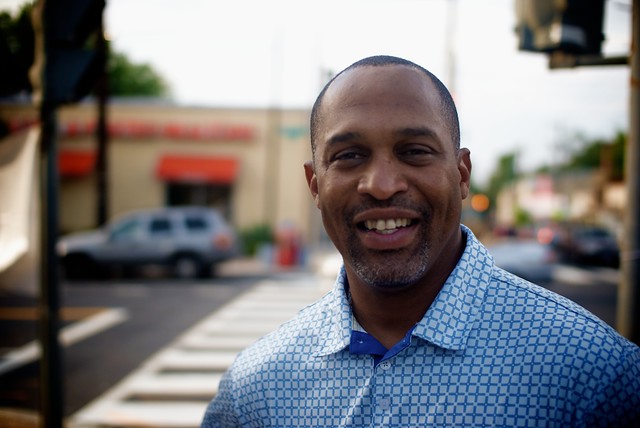
I'm often the first person to complain about what I perceive (and others agree) to be a lack of good customer service here in DC. When I see good service, though, I think it's worth shouting to the heavens so everyone knows about it. Tonight, that great service came from Jim at the CVS on Bladensburg Road next to the Hechinger Mall.
Jim was the security guard working the area near the front door. He was doing the work of a guard, as well as a greeter and a customer service representative. I had stopped in to purchase some salt in anticipation of the forecasted nasty weather, and saw a stack of salt bags near the front door. Not clear if these were for store employees to spread outside on the sidewalk, I asked Jim if I could purchase a bag.
"Absolutely," he replied. He reached down, lifted a bag, and walked it over to the scanner next to the aisle end-cap to let me know how much one cost. There were two women standing in front of the scanner, and Jim politely asked them to move so he could scan the bag. He was greeted with anything but politeness.
One of the women proceeded to berate Jim for a good 30 seconds, telling him with no uncertainty that she could do whatever she damn well pleased. Jim stood there and took it. When the rude misanthrope and her henchwoman finally decided to shuffle along, she made sure to loudly shout slurs and insults about Jim and his profession so everyone in the store could hear. I couldn't take it anymore and loudly responded, "Maybe if you spoke up, the whole city could hear you." I received a dirty look, and she left the store.
I turned to Jim and asked how he kept his composure. He replied, "When stupid people talk, I don't listen."
Jim walked the back to the self-checkout lanes for me, I thanked him for his kind service, and I payed for the bag and left the store. Yes, we can complain about the service we get in many retail establishments in DC, but witnessing first-hand the kind of crap these people have to endure reminded me to try even harder to be nice to everyone. Hopefully, you won't be the only one.
31 January 2011
28 December 2010
Will Thomas push for local business and good urban design?
Harry Thomas, Jr. will lead the DC Council's Committee on Economic Development next year. In a press release, Thomas notes his plans to continue "building on what he has accomplished in this area for Ward 5." The trouble is, Thomas' development record in Ward 5 is spotty, at best.
Suburban-style, big box-anchored retail development is scattered throughout Ward 5, such as Rhode Island Place, Rhode Island Avenue Center, and Hechinger Mall.
With part of Thomas' new duties including oversight of the Department of Small and Local Business Development (DSLBD), one might expect him to focus on revitalizing the city's struggling commercial corridors. Instead, we have a Councilmember who has often championed more of the status quo.
In his November 15 testimony before the DC Zoning Commission on proposed car and bike parking regulations in the zoning code, Thomas said,
We now know that Thomas was alluding to Dakota Crossing, with a planned 3,000 surface parking spaces, as well as the still developing plans for four Walmarts.
At the same time, Thomas knows very well what progressive urban infill looks like, and has helped usher it in during his tenure in Ward 5. Rhode Island Station, The Flats at Atlas District, and developments near Catholic University build on a multi- and mixed-use platform with retail space for small, local businesses.
While we continue to hear Thomas' lip service about the jobs and tax revenues that will be brought by new big boxes, our main streets continue to flounder. The Rhode Island Avenue Great Streets Initiative, for example, seems to have fallen off of DMPED's radar.
Can Thomas, who will have oversight of DMPED as Chair of the Committee on Economic Development, push for movement on a plan that could link the District's side of this important gateway with the revitalization that is happening just across the border in Mt. Rainier and Hyattsville?
While Brookland's 12th Street NE commercial strip received streetscape improvements, it still struggles to attract new businesses. North Capitol Main Street, Inc. continues to make strides in promoting local businesses, but will it find itself competing against a suffocating surge in big box, large-scale infill?
Will economic development East of the River under Thomas be focused on a blend of large- and small-scale development, or will bigger continue to be touted as better?
Thomas has proven an ability to work with developers and corporations on large projects. He knows the language of urban design and of Main Street commercial revitalization.
Unfortunately, a disconnect appears to exist between Thomas' advocacy for the bigger players and the smaller operators necessary to foster vital, dense cores in our neighborhoods. As he leads the Committee on Economic Development for the next four years, his actions will speak louder than words, particularly as we work our way out of the current recession.
Without a balance of both local and national retail outlets, small- and large-scale development, we will continue to see big box nodes favored to the detriment of our underutilized retail corridors, and we simply cannot afford that.
Cross-posted at Greater Greater Washington.
| Councilmember Thomas. Photo by mediaslave on Flickr. |
With part of Thomas' new duties including oversight of the Department of Small and Local Business Development (DSLBD), one might expect him to focus on revitalizing the city's struggling commercial corridors. Instead, we have a Councilmember who has often championed more of the status quo.
In his November 15 testimony before the DC Zoning Commission on proposed car and bike parking regulations in the zoning code, Thomas said,
"I have recently spoken with representatives of several retailers who are interested in developing large, multi-tenant shopping centers in the District.... There are ... a number of locations in Ward 5 and other outlying Wards with blocks of land large enough to accommodate these developments, but without convenient access to Metrorail. Placing a cap on parking citywide, in a one-size-fits-all approach, would limit the desirability of these locations and have an adverse economic impact on the District."
We now know that Thomas was alluding to Dakota Crossing, with a planned 3,000 surface parking spaces, as well as the still developing plans for four Walmarts.
At the same time, Thomas knows very well what progressive urban infill looks like, and has helped usher it in during his tenure in Ward 5. Rhode Island Station, The Flats at Atlas District, and developments near Catholic University build on a multi- and mixed-use platform with retail space for small, local businesses.
While we continue to hear Thomas' lip service about the jobs and tax revenues that will be brought by new big boxes, our main streets continue to flounder. The Rhode Island Avenue Great Streets Initiative, for example, seems to have fallen off of DMPED's radar.
Can Thomas, who will have oversight of DMPED as Chair of the Committee on Economic Development, push for movement on a plan that could link the District's side of this important gateway with the revitalization that is happening just across the border in Mt. Rainier and Hyattsville?
While Brookland's 12th Street NE commercial strip received streetscape improvements, it still struggles to attract new businesses. North Capitol Main Street, Inc. continues to make strides in promoting local businesses, but will it find itself competing against a suffocating surge in big box, large-scale infill?
Will economic development East of the River under Thomas be focused on a blend of large- and small-scale development, or will bigger continue to be touted as better?
Thomas has proven an ability to work with developers and corporations on large projects. He knows the language of urban design and of Main Street commercial revitalization.
Unfortunately, a disconnect appears to exist between Thomas' advocacy for the bigger players and the smaller operators necessary to foster vital, dense cores in our neighborhoods. As he leads the Committee on Economic Development for the next four years, his actions will speak louder than words, particularly as we work our way out of the current recession.
Without a balance of both local and national retail outlets, small- and large-scale development, we will continue to see big box nodes favored to the detriment of our underutilized retail corridors, and we simply cannot afford that.
Cross-posted at Greater Greater Washington.
06 December 2010
UPDATED: "There's a killer on your block"
Note: I have closed the comments for this post, because I'm concerned about the tone that has emerged there. To those who believe that we are casting a verdict in this case, please note that we simply wanted to show what we believed was a strange, and ultimately not productive, letter that we received. We fully believe in the presumption of innocence of anyone who has been accused of a crime. Mr. Kearney will have his day in court, and only then will innocence or guilt be determined. We have also made no judgments about the family, and will continue to remain unbiased observers of this story as it unfolds.
Original post continues below:
The deaths of Jamal Wilson and Joseph Alonzo Sharps, Jr., have been in the news quite a bit lately. The news hit close to home (literally) for us a few weeks ago when we heard the name of one of the accused in these crimes: Kwan Kearney. The Kearneys live down the street from us.
Things have been quiet on the block since the night that Kwan was arrested for these two homicides. News spread from neighbor to neighbor, and we've assumed that everyone nearby knows what has happened.
Apparently, though, someone wanted to make sure that we were fully aware of the situation. This arrived in the mail today:
It's an envelope with no return address (and no recipient name, just our address), containing a photocopied printout of this Washington Post article. As you can see, a note was added in large, bold print, alerting us that the accused lives on our block.
The note should have said "lived," because Kwan is currently in jail awaiting trial.
Tags:
homicide
21 November 2010
Bike tour of wards 5 and 7
Last Friday, I took a bike tour of parts of wards 5 and 7, taking a few photos along the way with my new smartphone (thanks, Credo Mobile!)
Here's a map of the route, with the photos embedded. The trip started at Oates Street and Trinidad Avenue, and headed north to the Trinidad Recreation Center.
View November 12th Bike Tour in a larger map
I just thought it would be fun to share a trip through some of the local neighborhoods. Enjoy!
Here's a map of the route, with the photos embedded. The trip started at Oates Street and Trinidad Avenue, and headed north to the Trinidad Recreation Center.
View November 12th Bike Tour in a larger map
I just thought it would be fun to share a trip through some of the local neighborhoods. Enjoy!
18 November 2010
What have we gained (and what have we lost)?
I'm too busy at work on a regular day to keep up with the news, so I generally don't write about the most up-to-date happenings in DC. The Walmart story, though, is far too big and consequential to not weigh in on in a timely fashion.
There are things that make Washington, DC unique: things that make us different from every other city in the country and give us a sense of pride. It seems like that specialness, that uniqueness is slipping away from us in some ways. Is it all important? In some ways it is, and it others, it really isn't, but I wanted to note how I feel about these things, while the feelings are fresh.
I wanted to focus on the things we didn't have.
We didn't have handguns. Sure, "when you make handgun ownership a crime, only criminals will own handguns," was a phrase we all heard a million times, but most of agreed with the ban. It's gone now, not just for DC, but for any other municipality in the United States, thanks to the Supreme Court.
We didn't have voting rights in Congress. Fought like hell for it the last few years, with ideas that seemed ingenious and workable (a seat for us, a seat for Utah), only to come out with nothing. With the results of the election two weeks ago, the chances of that changing any time soon are less than zero.
We didn't have Walmart. So what? Neither do most cities, if you think about it. But this mostly left-leaning city decided multiple times, when the retailing behemoth made overtures about crossing the line and setting up shop, that we didn't want them here. For reasons related to labor, mostly, Walmart stood on the outside looking in. Most of us agreed with this (well, maybe not this lobbyist), but it looks like they've wiggled their nose far enough under the tent this time.
This one divides people in strange ways. Some are excited about the possibility that they won't have to travel out to Landover Hills to get some goods cheaper. Some are enraged that a company with a reputation for not being fair to workers could get a foothold in the city. Some fear what will happen to small business in the city. My biggest fear is that Walmart will be able to steamroll any opposition, and I don't mean regarding their existence here. I mean opposition to locations, or site layout and design, or wage deals. Their PR machine helicoptered in and was ready to go at 100 miles per hour before anyone even knew what was happening. If that doesn't convince you that the fix is in, then nothing likely will.
What really makes DC unique, especially when compared to surrounding jurisdictions, is that we're a real, dense, urban city. Montgomery, Prince George's, Fairfax—even Arlington—they're not the same thing. A lot of us live here, or moved here, because of the uniqueness of that, vis-a-vis those surrounding counties. Many had a choice to live in suburbia or to live in the city. I chose the city. It looks like suburbia has decided they want to be here too.
At the end of the day, the one thing we didn't have, and really fought for, we still don't have.
12 November 2010
...my kingdom for a copy editor!
Capital Community News produces three monthly magazines, the Hill Rag, MidCityDC (formerly known as DC North), and East of the River. They're essentially community newspapers, focusing on a compact geographic area, covering everything from obituaries to restaurant openings to school plays. They do a decent job of reporting news, but could use a lot of work when it comes to copy editing.
I mentioned this at the end of September, and promised some more examples. After marking up every copy of the August, September, October, and November issues of the Hill Rag and MidCityDC, I came to the conclusion that there are just too many mistakes to share. It would take days to write about them all.
But, my need to curmudge knowsno few bounds, so I figured I should share some of them with you!
First up is the name of MidCityDC. I'm not certain that's the proper style. It's "MIDCITY DC" on the website, "MidCity DC" in the masthead (PDF), and "Midcity DC" in the footer on each page. It would seem that the switch from DC North to a new name came with some confusion about what that name really is.
The second thing that vexes me is the geographic breakdown of the monthly columns in MidCityDC. There are regular columns each month dedicated to telling stories and reporting news about Bloomingdale, Logan Circle, Shaw, and 14th and U Streets. The problem is that each month, most of the Logan Circle column is about 14th and U, which the author has inexplicably coined "U/14." I have never heard a living soul in this city use that moniker, and I'm curious if he's attempting to start a trend, or merely finds it funny. I realize, of course, that drawing a sharp line between the Logan Circle and 14th and U neighborhoods is difficult (see TBD's reporting on the naming of the Arts District in that part of the city). Perhaps the author of the 14th and U column (U Street Girl's Catherine Finn) could cover the whole Logan Circle/14th and U area, solving this toponymic disaster.
One more MidCityDC note is worth a chuckle. Richard Layman pointed this one out to me a last week. The cover of the August edition of the magazine is pictured to the left. Take note of the highlighted word on the cover. That's an example of where a little airbrushing might be acceptable, don't you think?
Finally, there's the Hill Rag. The ratio of advertising to content is about 5 to 1 (I didn't check this precisely, but it sure feels that way), but the content is usually worth reading. News that may have slipped through the cracks from the monthly ward 6 ANC meetings gets a full recount in this paper. Unfortunately, it's riddled with so many typographical errors and run-on sentences that it makes me cringe. Submitted for your approval, here are nine problems I found on one page this month. This isn't a large or unusual number.
1) The gentleman's name isRon Rob, not Rom, Amos. Double-checking the spelling of proper nouns is always a good idea.
2) Rogue number.
3) It appears that the author wrote "used to," then changed her mind to say "used for," and never deleted "to."
4) This paragraph should be indented, as it's part of the bullet point above.
5) An indefinite article ("a") should be put in front of "City Council" here.
6) Extra comma. The Hill Rag doesn't appear to have a standard for dealing with commas. Sometimes they use an Oxford comma, sometimes they do not. Unnecessary commas appear in places where they are not needed, creating awkward pauses that make for difficult reading.
7) AMI is not defined anywhere in this article. When using jargon and acronyms, it's a good idea to provide definitions for those who might be unfamiliar with the term.
8) Missing comma. That extra comma in number 6 could float down here and fix two problems.
9) Number 8 is actually part of a much bigger problem. This paragraph is one run-on sentence. It hurts to read it, and I dare someone to diagram it! Here it is, reprinted it its terrible glory:
Don't get me wrong, the Capital Community News stable of community newspapers are a valuable resource. It's just difficult to read without developing a small headache if you're an editor.
I mentioned this at the end of September, and promised some more examples. After marking up every copy of the August, September, October, and November issues of the Hill Rag and MidCityDC, I came to the conclusion that there are just too many mistakes to share. It would take days to write about them all.
But, my need to curmudge knows
First up is the name of MidCityDC. I'm not certain that's the proper style. It's "MIDCITY DC" on the website, "MidCity DC" in the masthead (PDF), and "Midcity DC" in the footer on each page. It would seem that the switch from DC North to a new name came with some confusion about what that name really is.
The second thing that vexes me is the geographic breakdown of the monthly columns in MidCityDC. There are regular columns each month dedicated to telling stories and reporting news about Bloomingdale, Logan Circle, Shaw, and 14th and U Streets. The problem is that each month, most of the Logan Circle column is about 14th and U, which the author has inexplicably coined "U/14." I have never heard a living soul in this city use that moniker, and I'm curious if he's attempting to start a trend, or merely finds it funny. I realize, of course, that drawing a sharp line between the Logan Circle and 14th and U neighborhoods is difficult (see TBD's reporting on the naming of the Arts District in that part of the city). Perhaps the author of the 14th and U column (U Street Girl's Catherine Finn) could cover the whole Logan Circle/14th and U area, solving this toponymic disaster.
One more MidCityDC note is worth a chuckle. Richard Layman pointed this one out to me a last week. The cover of the August edition of the magazine is pictured to the left. Take note of the highlighted word on the cover. That's an example of where a little airbrushing might be acceptable, don't you think?
Finally, there's the Hill Rag. The ratio of advertising to content is about 5 to 1 (I didn't check this precisely, but it sure feels that way), but the content is usually worth reading. News that may have slipped through the cracks from the monthly ward 6 ANC meetings gets a full recount in this paper. Unfortunately, it's riddled with so many typographical errors and run-on sentences that it makes me cringe. Submitted for your approval, here are nine problems I found on one page this month. This isn't a large or unusual number.
1) The gentleman's name is
2) Rogue number.
3) It appears that the author wrote "used to," then changed her mind to say "used for," and never deleted "to."
4) This paragraph should be indented, as it's part of the bullet point above.
5) An indefinite article ("a") should be put in front of "City Council" here.
6) Extra comma. The Hill Rag doesn't appear to have a standard for dealing with commas. Sometimes they use an Oxford comma, sometimes they do not. Unnecessary commas appear in places where they are not needed, creating awkward pauses that make for difficult reading.
7) AMI is not defined anywhere in this article. When using jargon and acronyms, it's a good idea to provide definitions for those who might be unfamiliar with the term.
8) Missing comma. That extra comma in number 6 could float down here and fix two problems.
9) Number 8 is actually part of a much bigger problem. This paragraph is one run-on sentence. It hurts to read it, and I dare someone to diagram it! Here it is, reprinted it its terrible glory:
Alex Nyhan, representing Forest City Washington, the Yards developer had presented an overview of the project at the September meeting, and returned to seek approval of the Zoning Commission, including a variance needed because the project is included in the Southeast Federal Center Zoning Overlay, and will be taller than the 90' height requirement that the Overlay specifies, and others to enable a curb cut for a loading dock, and balconies on the apartment building.
Don't get me wrong, the Capital Community News stable of community newspapers are a valuable resource. It's just difficult to read without developing a small headache if you're an editor.
11 November 2010
Fast food signs
This quick study shows two tall signs for fast food establishments. These are the kind of signs that you would usually see on an Interstate Highway, advertising an establishment to long-distance travelers approaching the exit.
First is the sign for a McDonalds at the corner of 9th and T Streets NE. It's in the middle of an area that's zoned industrial and commercial, with no residences for many blocks in every direction (map).
The second sign is for the Checkers just off of H Street in the northeast corner of Capitol Hill (map). This location is surrounded by residences, on the edge of the H Street commercial district.
I looked through the zoning regulations, expecting to find something that might hint that the Checkers sign would not be legal. It just seems so out of place in a residential neighborhood, especially one with the design rules of Capitol Hill. But the location is a few blocks north and east of the edge of the Capitol Hill Historic District, so the stricter rules that would probably preclude such signage don't apply here.
Tags:
historic districts,
signage,
zoning
Subscribe to:
Posts (Atom)